
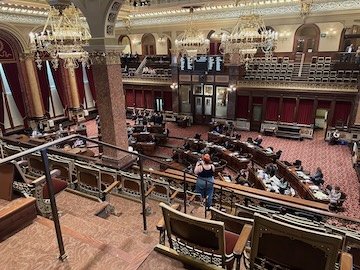
The 2026 session of the 91st General Assembly adjourned for the year on Sunday night after a marathon overnight session. Here’s what happened on the legislative front from the Iowa Catholic Conference (ICC) perspective … all of the bills mentioned were approved by the legislature.
The Senate during debate of HF 2788.
Lawmakers got a little testy with each other after 34 hours straight under the dome, particularly with the passage of HF 2788 in the Senate. The bill requires an in-person medical exam before drugs for an abortion can be provided. Although we do not support abortion, it is better to limit the possible harm to the mother by prohibiting drugs to be mailed from an unregulated website with no physician involvement. The bill is also specific about care being available to the mother in the event of a medical emergency. The ICC supported the bill, which now goes to the governor.
Interestingly, on Friday a federal appeals court put in place similar nationwide restrictions on the mailing of abortion drugs. Today, the Supreme Court put that ruling on hold for at least a week, so the story continues.
In the human services budget bill, the chambers allocated $1,493,299 in new money to the Iowa MOMS program for pregnancy support centers.
The “three strikes” bill opposed by the ICC passed both chambers late last night. An amendment improved HF 2542. A third felony conviction now will extend the minimum term of confinement to seven years (from the current three.) A so-called habitual offender may not have a deferred sentence. The original bill mandated a 20-year sentence served. Requiring mandatory sentences does not allow judges to consider individual circumstances, which may lead to unjust outcomes.
SJR 11 passed the House yesterday and will appear on the November ballot. If approved by Iowans, the constitutional amendment would require a two-thirds supermajority vote in both chambers to pass any increase to the corporate or personal income tax.
The ICC registered against the proposal. While works of charity will always be a personal responsibility, it does not substitute for what we can do as a community through the just collection and distribution of tax monies. Catholic teaching supports a more progressive form of taxation. This constitutional change, if approved by voters, would make it more likely that the legislature will raise the sales tax. The impact of our income tax and the sales tax now fall disproportionately on lower-income people because they tend to pay a higher percentage of their total income in those taxes. And everyone, no matter their income, pays a sale tax.
The Legislature hasn’t raised the income tax since 1975.
The ICC was also keeping an eye on property tax reform. The final proposal passed by the legislature included a 2% soft cap on the increase in local government revenue, an increased homestead tax exemption, and cut local school levies with the state picking up the cost. There is also a new First Home Iowa tax-deductible savings account program to help young Iowans begin preparing for homeownership.
One of the major priorities of the session for the ICC, HF 2754 includes a second sign-up window for Education Savings Accounts in the fall and access to the state preschool program for private providers through the Department of Education. It also passes along the public school “teacher salary supplement” to public charter schools. A separate bill approved by the legislature provided preschool access for community providers through the school districts.
After two years of work, we were pleased that HF 864 was approved by the legislature. It requires companies to verify someone’s age before a pornographic website can be visited. This policy could protect children by simplifying things for parents, some of whom are unaware that filtering options even exist on their devices or do not have the technical know-how to activate them. The Church is opposed to obscene material because it does grave injury to the human dignity of its participants.
Despite our efforts, SF 2218 passed both chambers. It requires all schools to use e-verify for new hires. Although many Catholic schools already use e-verify, we objected to the fact that private schools are now the only non-government agency in the state required to use the system. Private schools should not be considered government agencies just because parents use Education Savings Accounts — just as grocery stores that accept SNAP benefits are not government entities.
The original language of SF 2218 required all schools to make sure that their employees were authorized to work in the U.S. That stipulation was not a problem, but the legislature also added several proposals to the bill on citizenship verification and licensing for a variety of occupations, as well as a new presumption against bail for additional classes of people, including undocumented immigrants with an indictable offense (could be a non-felony).
The ICC opposed HF 2711, which eliminates state policies to use “affirmative action” to correct deficiencies in the state employment system. The bill also eliminates required racial and cultural bias training for law enforcement.
For the last couple of months, state legislators have been working on SF 2422 to implement provisions of last year’s federal H.R. 1, the One Big Beautiful Bill Act. The ICC supported an amendment to SF 2422 which removed a proposed 12-month residency requirement for federal public assistance programs like SNAP, Medicaid and WIC.
Unfortunately, the bill goes beyond OBBBA in cutting retroactive coverage for prospective Medicaid recipients. Now, in some cases, lower-income people who suffer a medical emergency with no health insurance will not have any coverage for the emergency. Without coverage, a bankruptcy is much more likely.
In a piece of good news, a $1 million appropriation for Double Up Food Bucks was included at the last minute. It is a matching fund allowing users of SNAP to buy twice the amount of fruits and vegetables per dollar. The legislature also approved $200,000 for the Choose Iowa program for schools to purchase locally produced food.
The agriculture budget included a new proposal from Gov. Reynolds on water quality. It provides more than $300 million in funding over the next 12 years. There is some new money and some shifting around of funds. It increases funding for the Wastewater and Drinking Water Treatment program. It also offers $8 million in grants to communities for water projects, up to $1 million; a $500,000 increase for water monitoring and $3.7 million in conservation efforts for the Des Moines watershed. The proposal includes a $10 million revolving loan fund for rural areas and a one-time grant of $25 million for nitrate removal for Central Iowa Waterworks.
On the specific issue of the $600,000 funding request the ICC supported for the water quality monitoring system located at the University of Iowa, the budget includes $300,000 sent to the Iowa Department of Agriculture and Land Stewardship (IDALS) and the department will decide on exactly where it goes.
Pope Leo supports those working to end the death penalty
Pope Leo XIV recently released a video encouraging the work of those who advocate to end the death penalty. By coincidence, this was the same day that the Department of Justice released its report on “Restoring and Strengthening the Federal Death Penalty,” including its intentions to add the firing squad as a method of execution at the federal level.
And finally,
Thanks to all of you who sent a message to legislators this session!

