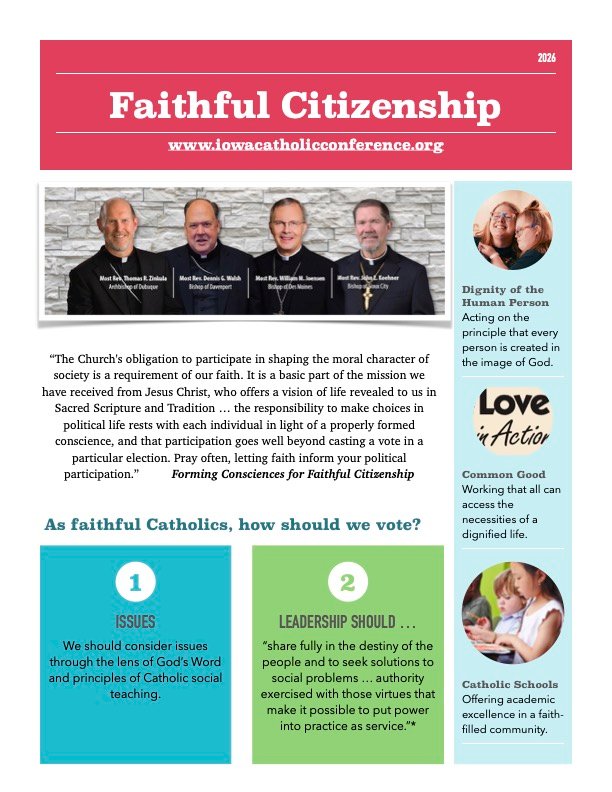
ICC releases Faithful Citizenship flyer
Voting for the mid-term elections in Iowa begins in October and continues through Election Day, Nov. 3. As the U.S. bishops’ document, “Forming Consciences for Faithful Citizenship,” says: “The Church’s obligation to participate in shaping the moral character of society is a requirement of our faith. It is a basic part of the mission we have received from Jesus Christ, who offers a vision of life revealed to us in Sacred Scripture and Tradition.”
The Iowa Catholic Conference offers a flyer in English and Spanish to help in your discernment about how to participate in the political process. Videos from the Iowa bishops will be following soon.
Medicaid coverage for legal refugees to end
Medicaid health insurance coverage for refugees who have not received their green card (legal permanent resident status) will end Oct. 1 because of H.R. 1. We believe this will affect a minimum of a thousand refugees in Iowa who often lived in camps overseas for many years before they were resettled here by the federal government. Coverage of children is expected to continue.
Refugees cannot apply for a green card until a year after arrival and there is a slowdown in consideration of the applications.
The ICC is working with advocates for refugees and newcomers on ways to alleviate the situation in the short term and we are working on a proposal for the 2027 session.
Bishops write in support of TPS
The bishops of Iowa have written to Senators Ernst and Grassley in support of legislation to require the extension of Temporary Protected Status for people from Haiti. TPS offers the right to work and, thus, the legal stability to support a family. The bishops said in order to “do things the right way,” people must first have realistic options available to them.
Unfortunately, so many of these families will soon find themselves without any lawful status or means of support, even as returning to their country of origin remains unsafe, impractical, and unreasonable given the ongoing conditions there.
You can join the bishops and send a message here.
Accountability for Education Savings Accounts
There is interest in accountability for Education Savings Accounts. The ICC estimates the state spent about $330 million on ESAs during the past school year, or a little less than 4% of government spending on public schools. ESAs can be used for tuition at an accredited nonpublic school or other limited expenses. Public school districts collect about $1,600 for each student who receives an ESA.
Some safeguards in the program:
- The Department of Education verifies the eligibility of each child to ensure compliance and prevent fraud. The Department may also audit or review the program.
- As many of you are aware from experience, money in the ESA program is never deposited into parents’ personal bank accounts, nor do they handle cash or receive checks. It is placed into a digital wallet controlled and administered by a third-party program manager named Odyssey.
- The parent initiates or approves transactions through the Odyssey Portal or app. However, the money moves completely inside Odyssey’s closed financial system. The program strictly prohibits cash reimbursements. If a transaction happens outside of Odyssey’s system, it is entirely ineligible for funding.
- If there are leftover funds after tuition is fully cleared, parents can spend the remaining balance on other approved educational items (like textbooks, tutoring, or laptops). However, these can only be bought through pre-approved businesses inside the digital Odyssey Marketplace.
- What is strictly ineligible? Things like everyday school supplies, lifestyle items, cell phones, smartwatches, video game consoles, backpacks, school uniforms, shoes, athletic clothes or gear, school lunches, transportation costs, summer or sports camps.
- Unused funds carry over from year to year as long as the student is enrolled. However, once the student graduates from high school or turns 20 years old, any remaining money is returned to the state General Fund.
- If a nonpublic school does not adhere to everything necessary to be accredited, the accreditors will pull the plug on them. That means they are a school whose students are no longer eligible to receive ESA funds. In fact, this has happened.
Celebrate the Jubilee Year of Saint Francis with the Feast of St. Francis program
Pope Leo XIV established the special Jubilee Year of St. Francis of Assisi on the occasion of the 800th anniversary of the saint’s Transitus to Heaven. The year invites us to embrace simplicity, peace, and spiritual renewal and to transform our hope into concrete action.
This year’s Feast of St. Francis program, “All of Creation Sings,” will guide participants through 90-minutes of prayer, reflection, discussion, and suggested actions. You can download the program here.